Views: 237 Author: Reshine Display Publish Time: 2026-04-08 Origin: Reshine Display


Content Menu
● The Hidden Danger of UV Radiation: Why Industrial HMI/IPC Displays Fail Prematurely
>> Material Deterioration and Structural Failure
>> Production Risks and Economic Losses
>> Industry-Specific UV Exposure Scenarios
● Core Standards for Industrial-Grade Anti-UV Touchscreens: What Makes a Qualified Solution?
>> High-Efficiency UV Blocking Rate
>> Compatibility with Industrial Environment Adaptability
>> Structural and Material System Optimization
● Reshine Anti-UV Touchscreen: Customized Solutions for Industrial HMI/IPC
>> Core Product Performance: Data Speaks for Reliability
>> Customization Capabilities for Industrial Scenarios
>> Strict Quality Control and Supply Chain Stability
● Why Choose Reshine Anti-UV Touchscreen for Your Industrial HMI/IPC?
>> Solve Pain Points at the Root, Not Just Symptomatic Treatment
>> Balance Technical Performance and Cost-Efficiency
>> Deep Industry Experience and Customized Service
● Your Questions About Industrial HMI/IPC Anti-UV Touchscreens Answered
>> Q1: How to verify the actual anti-UV performance of the touchscreen?
>> Q2: Can the anti-UV touchscreen be customized to meet extreme temperature requirements?
>> Q3: What is the lead time for customized anti-UV touchscreens?
● Get Your Custom Anti-UV Solution Today
In industrial automation environments, Human-Machine Interfaces (HMI) and Industrial PCs (IPC) are the core of production control—yet their touchscreen displays face a hidden threat: ultraviolet (UV) radiation. Whether installed near factory skylights, outdoor production areas, or semi-enclosed workshops, long-term UV exposure causes irreversible damage to displays, leading to frequent failures, production downtime, and soaring maintenance costs. According to industry data, ordinary touchscreens without UV protection have a failure rate increase of 18-23% within 3 years, and their service life is shortened by 50% compared to the designed lifespan.
Reshine Display's newly launched anti-UV touchscreen samples target these pain points, with a UV radiation (UVR) blocking rate of up to 100%. This article will deeply analyze the hazards of UV radiation to industrial HMI/IPC displays, interpret the core technical standards of anti-UV solutions, and detail how our customized products help industrial automation enterprises reduce costs and increase efficiency.
Ultraviolet light (200-400nm) penetrates conventional display materials through photochemical reactions, attacking the molecular structure of key components and triggering a chain of degradation reactions. For industrial control scenarios, the damage is mainly reflected in four aspects:
• Polarizing film yellowing: UV breaks the iodine molecular chains in polarizing films, reducing light transmittance by 14-25% within 1-2 years. Displays in sunlit workshops often appear "cloudy" or show rainbow patterns, making process parameters unreadable.
• Adhesive aging and delamination: Ordinary SAC (Solid Acrylic Adhesive) materials lose their bonding properties under UV irradiation, leading to separation between the cover glass and sensor. This not only causes touch failure but also reduces the display’s dustproof and waterproof performance (IP rating), allowing moisture and particles to enter the internal circuit.
• Liquid crystal molecule decomposition: UV energy breaks the carbon-carbon double bonds of liquid crystals, resulting in a 15-20% decrease in contrast and a 30% extension in response time. In severe cases, dead pixels and color distortion occur, directly affecting the accuracy of production data monitoring.
For industrial enterprises, display failures caused by UV degradation are not just equipment maintenance issues—they trigger a series of chain reactions:
• Downtime costs: A single HMI display failure can cause hours of production line stoppage. For medium-sized manufacturing enterprises, the average hourly loss exceeds $5,000.
• Safety hazards: Faded markings, blurred color-coded indicators, and unreadable process data increase the risk of operational errors. In high-precision manufacturing or dangerous production links, this may even lead to safety accidents.
• Increased maintenance costs: Frequent replacement of displays not only consumes procurement budgets but also occupies maintenance resources. Statistics show that UV-related display replacements account for 35% of annual maintenance costs for industrial control equipment.
Industrial HMI/IPC displays face UV threats in multiple scenarios:
• Workshops with natural lighting: Skylights and large windows allow direct sunlight to irradiate displays for 4-6 hours a day.
• Outdoor industrial control stations: Equipment used in construction sites, mining areas, and outdoor production lines is exposed to full UV radiation.
• High-temperature environments: Industrial workshops with temperatures above 40°C accelerate UV-induced material aging, as heat stress and UV radiation act synergistically to damage displays faster.
To solve UV degradation problems, industrial HMI/IPC touchscreens must meet strict technical standards, not just "surface anti-UV treatment." Based on international standards such as ASTM G154, ISO 4892-3, and IEC 60068-2-5, combined with industrial automation requirements, qualified anti-UV displays should meet three core criteria:
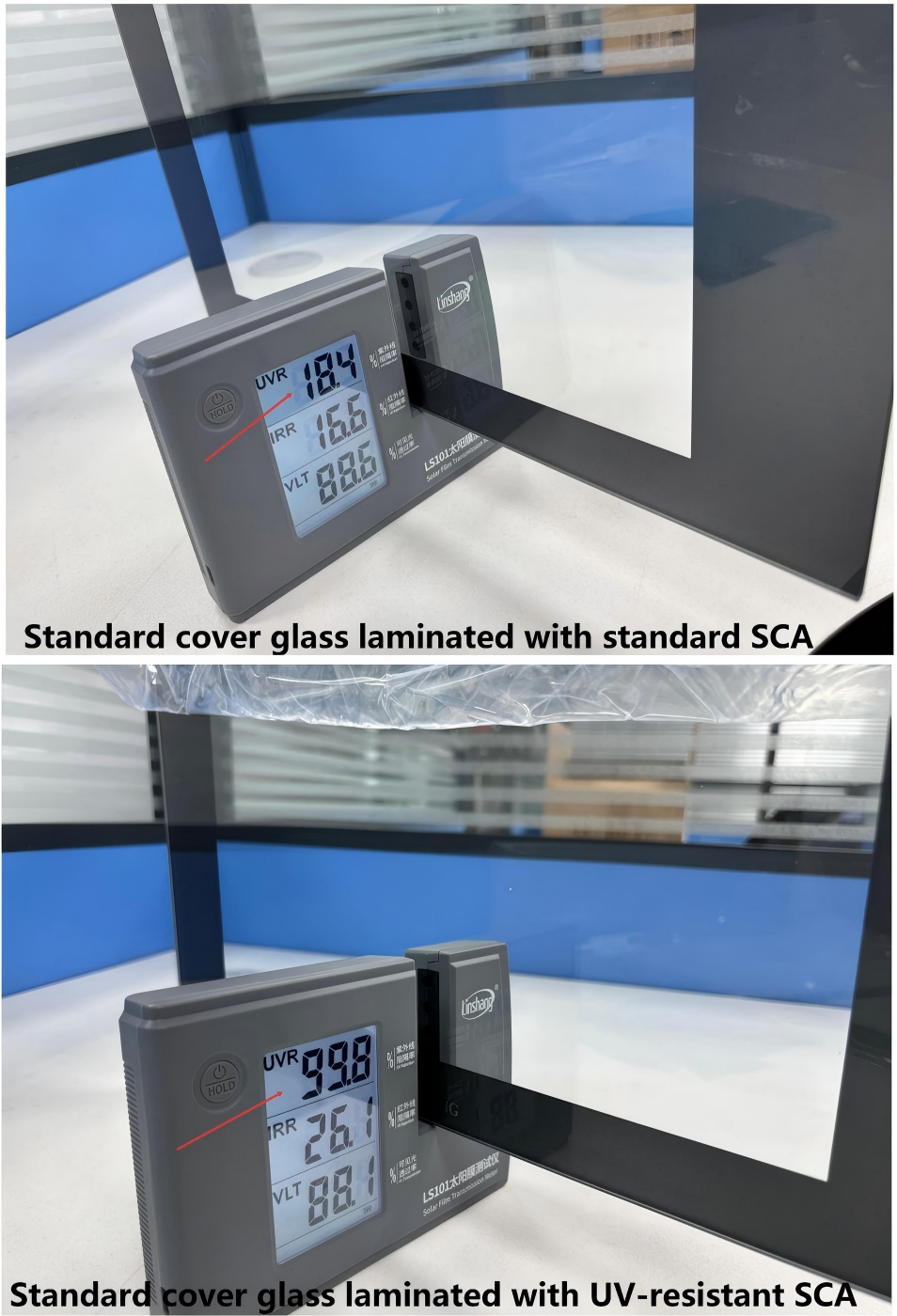
• The UVR blocking rate for 315-400nm (UVA/UVB) must exceed 99%, which is the minimum requirement to prevent material degradation. Ordinary SAC materials only block 18.4% of UV radiation, far from meeting industrial needs.
• Long-term stability: After 1000 hours of accelerated UV aging testing (simulating 5 years of outdoor use), the blocking rate should not decrease by more than 1%, ensuring consistent protection throughout the product lifecycle.
Anti-UV performance cannot be at the expense of other industrial-grade characteristics. Qualified products must achieve "multi-protection integration":
• Wide temperature range: Stable operation at -20°C ~ 70°C, adapting to temperature fluctuations in workshops and outdoor environments.
• High protection grade: IP65 or above dustproof and waterproof performance, matching the harsh conditions of industrial sites.
• Anti-glare and high brightness: 800+ nits brightness and AG/AF anti-glare coating to ensure readability under direct sunlight, solving the "double challenge" of UV protection and visibility.
Effective UV protection requires systematic design, not just a single layer of coating:
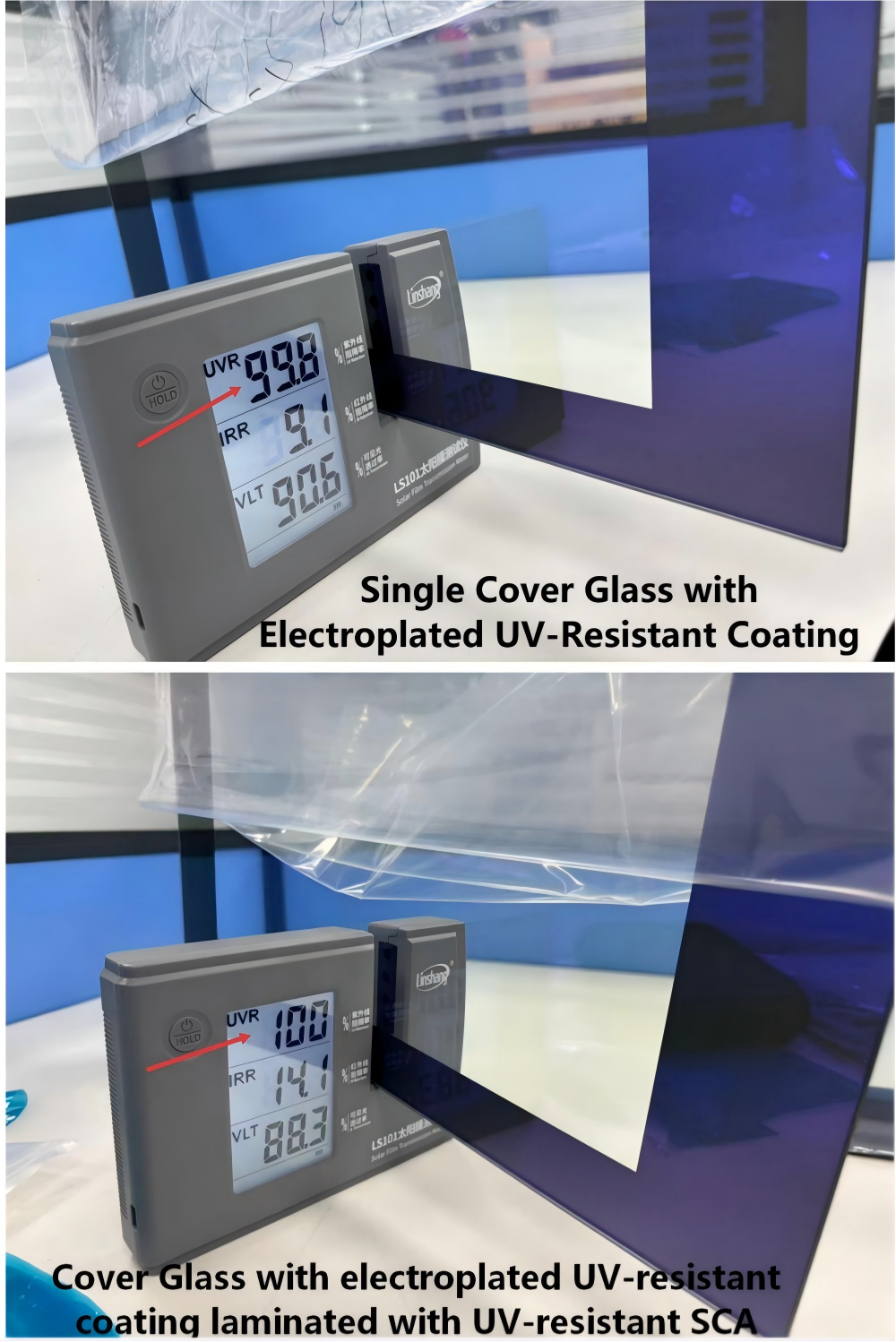
• Cover glass: Chemically strengthened glass with anti-UV coating, forming the first barrier against UV radiation. The visible purple reflective layer (a sign of effective anti-UV coating) can block 99.8% of UV rays alone.
• Optical bonding material: Anti-UV SAC (Solid Acrylic Adhesive) instead of ordinary adhesive, preventing UV rays from penetrating the bonding layer to damage internal components.
• Integrated structure: Cover glass + anti-UV SAC + sensor + LCD panel multi-layer bonding, forming a closed UV protection system. This structure not only improves blocking efficiency but also enhances shock resistance and dustproof performance.
Based on 16 years of experience in industrial display manufacturing, Reshine Display has launched two anti-UV touchscreen samples tailored to the needs of HMI/IPC applications. With verified test data and flexible customization capabilities, they solve the pain points of UV degradation for industrial automation enterprises.
Our anti-UV touchscreens have passed strict third-party testing, meeting international industrial standards:
Performance Indicator | Anti-UV SAC Touchscreen | Anti-UV Coated Glass + Anti-UV SAC Assembly | Ordinary Display |
UVR Blocking Rate (315-400nm) | 99.8% | 100% | 18.4% |
Accelerated UV Aging Test (ASTM G154) | No yellowing after 1000 hours | No performance attenuation after 1500 hours | Yellowing after 300 hours |
Operating Temperature Range | -20°C ~ 70°C | -20°C ~ 70°C | -10°C ~ 60°C |
Protection Grade | IP65 | IP65/IP67 optional | IP54 |
Brightness | 800-1500 nits | 1000-2500 nits | 500-800 nits |
Key technical advantages:
• Dual anti-UV mechanism: The first sample uses anti-UV SAC material to block 99.8% of UV rays, suitable for semi-outdoor or indoor high-UV environments. The second sample adds an anti-UV coated cover glass, achieving 100% blocking rate for full-outdoor industrial control scenarios.
• Visible quality assurance: The anti-UV coated glass has a unique purple reflective layer (visible to the naked eye), allowing customers to directly verify the anti-UV function without professional testing equipment.
• Long lifespan design: The service life of the display is extended to 8-10 years, 2-3 times that of ordinary products, significantly reducing replacement frequency and maintenance costs.
Industrial HMI/IPC displays have diverse form factors and interface requirements. Reshine provides full-scenario customization to avoid "one-size-fits-all" limitations:
• Size range: 2.4" - 32", supporting embedded, desktop, and wall-mounted HMI/IPC designs.
• Interface compatibility: LVDS, MIPI, RGB interfaces, matching mainstream industrial motherboards and control systems.
• Additional functional customization: Anti-glare (AG) coating for high-light workshops, anti-fingerprint (AF) treatment for frequent operation, and optical bonding for harsh vibration environments.
• No MOQ restrictions: Whether it’s a prototype for R&D projects or mass production for large-scale deployment, we provide flexible supply support with sample delivery in 12-15 days.
As a professional industrial display manufacturer, we adhere to the principle of "reliable quality as the core":
• Certification guarantee: ISO 9001 quality management system and SGS certification, ensuring that each product meets industrial-grade reliability standards.
• Production capacity: 10,000㎡ factory and 750,000 pieces/month production capacity, supporting large-scale project delivery without supply shortages.
• Technical support: A dedicated R&D team provides one-stop services from product selection, structural design to after-sales maintenance, solving compatibility and integration problems for customers.
For industrial automation enterprises, choosing an anti-UV touchscreen is not just a product purchase—it’s an investment in production stability and cost control. Reshine’s solutions stand out in three core aspects:
Unlike ordinary displays with simple UV coating (which wears off after 6-12 months), our products adopt a systematic anti-UV design from materials to structure. The 99.8%-99.9% UVR blocking rate fundamentally prevents UV-induced degradation, avoiding the "replacement cycle trap" of ordinary displays.
We understand that industrial projects focus on long-term ROI. Our anti-UV touchscreens increase the initial procurement cost by only 8-12% but reduce maintenance costs by 60% and extend the display lifespan by 2-3 times. For a production line with 50 HMI devices, the total cost of ownership (TCO) can be reduced by $30,000-50,000 within 5 years.
With 16 years of cooperation with industrial automation brands, we deeply understand the unique needs of HMI/IPC applications:
• For engineers: Provide detailed technical specifications, interface compatibility testing, and structural design suggestions to ensure seamless integration.
• For buyers: Offer transparent pricing, flexible MOQ, and on-time delivery to avoid project delays.
• For CEOs: Provide total cost of ownership analysis reports, helping enterprises optimize procurement budgets and improve operational efficiency.
A1: We provide third-party test reports (ASTM G154 and ISO 4892-3 standards) for each batch of products. Customers can also conduct on-site verification: use a professional solar film tester to measure the UVR blocking rate, or observe the purple reflective layer on the cover glass (unique to our anti-UV coating technology).
A2: Yes. We can optimize the material and circuit design to expand the operating temperature range to -30°C ~ 85°C, suitable for high-cold or high-temperature industrial environments (such as northern workshops or smelting plants).
A3: Samples are delivered in 12-15 days, and mass production lead time is 25-35 days. For urgent projects, we can provide expedited services to meet your project schedule.
UV degradation is no longer an inevitable problem for industrial HMI/IPC displays. Reshine Display’s anti-UV touchscreens, with 100% UVR blocking rate, industrial-grade reliability, and full customization capabilities, help you eliminate hidden risks of production downtime and reduce long-term maintenance costs.
Take Action Now:
• Visit our official website: https://www.reshine-display.com/ to view detailed product specifications.
• Contact our technical team for customized solutions: Provide your HMI/IPC model, installation environment, and technical requirements, and we will reply with a tailored proposal within 24 hours.
Reshine Display—your trusted partner for industrial-grade touchscreen solutions, protecting your production line with reliable anti-UV technology.