
Views: 222 Author: Wendy Publish Time: 2025-12-25 Origin: Site


Content Menu
● Japan's Resistive Touch Screen Ecosystem
● How Resistive Touch Screen Technology Works
● Advantages of Resistive Touch Screen in Industrial Use
● Representative Japanese Resistive Touch Screen Manufacturers
● DMC Co., Ltd.: Industrial Resistive Touch Screen Specialist
● RHYTHM SHOEI CO., LTD.: Glass‑Glass and Industrial Panels
● Fuji Electric MONITOUCH: Integrated HMI Terminals
● Technical Characteristics of Japanese Industrial Resistive Touch Screen
● Main Application Fields in Japan
● Design Choices: 4‑Wire vs 5‑Wire Resistive Touch Screen
● Environmental and Mechanical Considerations
● Integration of Resistive Touch Screen with Displays
● Balancing Resistive vs Capacitive Touch in Japanese Projects
● Sourcing and Cooperation Models for Global OEMs
● Practical Tips for Selecting a Japanese Resistive Touch Screen Partner
● FAQ About Japanese Resistive Touch Screen Suppliers
>> (1) Why choose a Japanese manufacturer for Resistive Touch Screen projects?
>> (2) In which applications is a Resistive Touch Screen better than capacitive?
>> (3) What information should be provided when requesting a quote?
>> (4) Can Japanese suppliers customize the shape and design of a Resistive Touch Screen?
>> (5) How long is the typical lifecycle of an industrial Resistive Touch Screen product?
Japan is one of the most important global hubs for industrial Resistive Touch Screen solutions, especially for automation, medical devices, transportation, kiosks, and professional HMI systems. Choosing a Japanese Resistive Touch Screen manufacturer or supplier helps global OEMs secure high reliability, strict quality control, and long‑term technical support.

Japan's ecosystem mixes specialized Resistive Touch Screen panel makers, broader touch‑and‑display manufacturers, and HMI solution providers that integrate touchscreens into finished operator panels. Many suppliers focus on long‑lifecycle industrial Resistive Touch Screen products rather than short‑term consumer devices.
- Japan is known for rigorous quality management, traceability, and environmental testing for Resistive Touch Screen modules used in harsh environments.
- Buyers can source both standalone Resistive Touch Screen sensors and fully integrated display‑plus‑touch modules from Japanese manufacturers.
A Resistive Touch Screen typically has two transparent conductive layers (often ITO‑coated film or glass) separated by spacers; when pressure is applied, the layers contact and the controller detects position through voltage changes. Because the technology responds to pressure, a Resistive Touch Screen can be operated with fingers, stylus, gloved hands, or even tools.
- 4‑wire and 5‑wire Resistive Touch Screen structures are common, with 5‑wire models generally offering higher durability for industrial use.
- Compared with capacitive technology, a Resistive Touch Screen is usually more affordable and less sensitive to water droplets or electrical noise when properly designed.
A Resistive Touch Screen remains popular in industrial, medical, and outdoor environments where robustness and input flexibility are more important than multi‑touch gestures. Japanese manufacturers optimize their Resistive Touch Screen designs for long service life, high clarity, and stable linearity.
- A Resistive Touch Screen supports precise stylus input, suitable for small on‑screen buttons or handwriting fields in HMI and data‑entry applications.
- Resistive Touch Screen panels can be tuned for low activation force, allowing a light‑touch experience closer to modern capacitive screens.
Several Japanese manufacturers are widely recognized in the global touch‑and‑display industry and supply Resistive Touch Screen products or integrated HMIs.
- DMC Co., Ltd.: Known for industrial Resistive Touch Screen panels and modules, including light‑load series designed to feel more like capacitive touch while keeping resistive benefits.
- RHYTHM SHOEI CO., LTD.: Supplies industrial‑grade resistive touch panels, including glass‑glass structures with high durability and good optical performance.
- Fuji Electric (MONITOUCH): Provides integrated HMIs where Resistive Touch Screen panels are combined with industrial‑grade displays and powerful configuration software.
- Other players such as Kyocera, Gunze, and Futaba contribute with displays and touch solutions that can incorporate Resistive Touch Screen technology for specific applications.
These companies help OEMs and integrators build complete solutions centered on reliable Resistive Touch Screen interfaces.
DMC is considered a key industrial touch brand in Japan, offering both Resistive Touch Screen and capacitive touch solutions for demanding applications. Its light‑load resistive series targets customers who want a softer, more modern touch feeling but still require glove and stylus operation.
- DMC supplies standalone Resistive Touch Screen sensors as well as full modules that combine touch, cover glass, and display.
- The company designs its Resistive Touch Screen products to operate in environments with vibration, temperature variation, and electrical noise.
RHYTHM SHOEI CO., LTD. focuses on touch panel manufacturing and provides industrial Resistive Touch Screen models suited for equipment front panels and instruments. Its glass‑glass resistive designs offer strong protection against impact and scratches.
- Customers can select various Resistive Touch Screen structures, sizes, and tail formats to fit their electronics and mechanical designs.
- Options such as cover glass integration, printing, and surface treatments help tailor the resistive touch panel to the branding and ergonomic requirements of the final product.
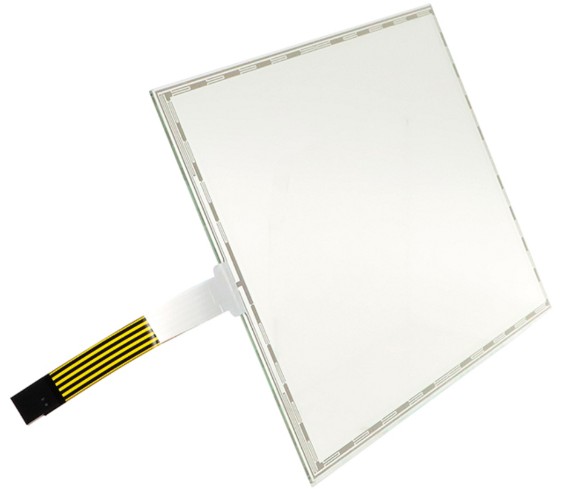
Fuji Electric's MONITOUCH series combines displays, touchscreens, and control software into complete HMI terminals. Many models have historically used Resistive Touch Screen panels to guarantee stable operation in factory and infrastructure environments.
- MONITOUCH panels with Resistive Touch Screen fronts support operation in oily, dusty, or humid conditions and are compatible with various types of gloves.
- These HMIs pair the Resistive Touch Screen hardware with powerful configuration tools, network drivers, and long‑term support, reducing engineering workload for OEMs.
Japanese suppliers pay close attention to the technical parameters that influence real‑world performance of a Resistive Touch Screen. This approach ensures consistent behavior during long service lives.
- Important parameters include optical transparency, haze, surface hardness, linearity, response time, operating force, and lifetime measured in touch cycles.
- Advanced Resistive Touch Screen models may include anti‑glare or anti‑reflection coatings, chemical‑resistant surfaces, and customized flex tails for easy integration.
By fine‑tuning these characteristics, manufacturers deliver Resistive Touch Screen panels that match the demanding expectations of industrial OEMs.
Most Japanese Resistive Touch Screen suppliers focus on professional and industrial applications where reliability, service life, and input flexibility matter more than multi‑touch features.
- Typical fields include factory automation HMIs, CNC machine panels, pharmaceutical and food processing lines, laboratory analyzers, medical devices, smart terminals, ticketing machines, and transportation systems.
- In these scenarios, a Resistive Touch Screen must withstand frequent operation, cleaning procedures, and occasional misuse while still providing accurate input detection.
When planning a new project, engineers often need to choose between 4‑wire and 5‑wire Resistive Touch Screen technologies. Japanese manufacturers usually support both.
- 4‑wire Resistive Touch Screen designs are cost‑effective and suitable for many standard applications where expected lifetime and environmental demands are moderate.
- 5‑wire Resistive Touch Screen panels place most of the sensing function on one layer, which usually improves durability and stability for heavy‑duty industrial use.
Selecting the right structure helps balance cost, robustness, and performance.
Industrial deployments in Japan and worldwide expose Resistive Touch Screen panels to varied mechanical and environmental conditions. As a result, environmental design is a core focus.
- Enclosures may need to meet specific sealing levels, and the Resistive Touch Screen is often paired with gaskets and cover glass to achieve those ratings.
- Mechanical design must consider bezel pressure, mounting tolerances, and the potential for shock and vibration so that the Resistive Touch Screen remains stable and responsive.
Working closely with Japanese suppliers during the design phase helps avoid mechanical stress and premature wear.
Many Japanese suppliers offer not only bare Resistive Touch Screen sensors but also integrated display modules. This integration simplifies assembly and reduces risk for OEMs.
- An integrated module can combine LCD, backlight, Resistive Touch Screen, cover glass, and sometimes a controller board into a single unit.
- This approach minimizes optical reflections between layers, saves assembly time, and allows the supplier to guarantee performance of the complete Resistive Touch Screen display stack.
For customers, modular integration shortens development cycles and improves reliability.
Even though projected capacitive (PCAP) technology dominates consumer electronics, Japanese industrial projects still rely heavily on Resistive Touch Screen solutions when conditions justify them.
- PCAP excels at multi‑touch gestures and modern UI experiences, while a Resistive Touch Screen excels at compatibility with gloves, styluses, and challenging contamination.
- Many Japanese vendors offer both technologies, helping customers compare and select the best solution for each application segment.
In some projects, hybrid product lines let OEMs provide both resistive and capacitive variants using similar mechanical platforms.
Overseas OEMs and system integrators have several ways to cooperate with Japanese Resistive Touch Screen suppliers. Good communication and documentation are critical to success.
- A typical path is: requirements definition, drawing exchange, engineering sample order, prototype validation, pilot production, and finally mass production under a long‑term agreement.
- Some customers work through local agents or trading companies that manage logistics, communication, and after‑sales support while still relying on Japanese Resistive Touch Screen manufacturing.
Using clear specifications and structured testing plans helps align expectations on both sides.
To choose the right partner, buyers should evaluate both technical capabilities and business conditions related to Resistive Touch Screen production.
- From a technical standpoint, confirm structure (4‑wire or 5‑wire), size and aspect ratio, transparency, surface treatment, controller interface, and environmental ratings.
- From a commercial perspective, look at minimum order quantities, lead times, price stability, lifecycle commitments, customization options, and responsiveness of engineering support.
Shortlisting two or three Japanese Resistive Touch Screen suppliers and comparing prototypes under real conditions can greatly reduce project risk.
Japan offers a mature, high‑reliability ecosystem for industrial Resistive Touch Screen manufacturing, led by specialists such as DMC and RHYTHM SHOEI and supported by integrated HMI brands like Fuji Electric MONITOUCH. For OEMs and integrators worldwide, choosing a Japanese Resistive Touch Screen partner delivers robust, glove‑friendly interfaces, stable long‑term supply, and strong engineering collaboration tailored to demanding industrial, medical, and transportation environments.

Japanese manufacturers are known for strict quality control, detailed documentation, and stable long‑term production, which are crucial for industrial Resistive Touch Screen applications. Their engineering teams also help optimize design details so the Resistive Touch Screen performs reliably over the full product lifecycle.
A Resistive Touch Screen is especially suitable for environments involving gloves, stylus input, frequent cleaning, or significant dust and moisture. Many factories, medical instruments, and transportation kiosks still prefer Resistive Touch Screen technology because it remains reliable when multi‑touch gestures are not the priority.
When contacting a Japanese supplier, buyers should share size, viewing area, 4‑wire or 5‑wire structure, cover‑glass requirements, interface type, operating environment, and expected annual volume. Providing mechanical drawings and example UI layouts helps the Resistive Touch Screen manufacturer make accurate proposals and pricing.
Yes, many Japanese suppliers support custom shapes, cut‑outs, printing, logo areas, and special tail layouts for Resistive Touch Screen projects. These customizations ensure that the Resistive Touch Screen fits the enclosure perfectly and aligns with the brand's visual and ergonomic requirements.
Industrial Resistive Touch Screen products are often maintained for many years so OEMs can keep the same front panel design without frequent redesigns. Exact lifecycles vary by supplier and series, but industrial product lines usually provide much longer availability than consumer‑oriented touch solutions.